
Fitch Ratings on Thursday cut India's GDP growth estimate by 10 basis points to 6.4 per cent for the current fiscal, but retained the projections for the next financial year, on concerns over a 'severe' escalation in global trade war. "It is hard to predict US trade policy with any confidence. Massive policy uncertainty is hurting business investment prospects, equity price falls are reducing household wealth, and US exporters will be hit by retaliation," Fitch said in its special update to quarterly Global Economic Outlook (GEO).

Simplifying GST rates, removing exemptions, easing disputes, and speeding up refunds can boost investment in India and offer the best reply to Trump's tariffs, observes V S Krishnan, former member, Central Board of Indirect Taxes and Customs.

Moody's Ratings on Wednesday said India's economic growth will exceed 6.5 per cent in the next fiscal, up from 6.3 per cent this year, on higher government capex and consumption boost from tax cuts and interest rate reduction. Projecting a stable outlook for the banking sector, Moody's said although the operating environment of Indian banks will remain favourable in the next fiscal, their asset quality will deteriorate moderately after substantial improvements in recent years, with some stress in unsecured retail loans, microfinance loans and small business loans.

State-owned insurer Life Insurance Corporation of India (LIC) on Tuesday posted a 38 per cent increase in net profit to Rs 19,013 crore in the fourth quarter ended March 2025 helped by lower expenses. The country's biggest insurer had earned a profit of Rs 13,763 crore in the corresponding quarter a year earlier.

India had vehemently opposed Asian Development Bank's decision to grant $800 million loan to Pakistan saying the fund could be misused for increasing expenditure on its military, government sources said.

Passenger vehicle dispatches in India from factories to dealers rose to record levels at over 43 lakh units in FY25, with utility vehicles accounting for 65 per cent of the total sales in the segment, industry body SIAM said on Tuesday. Passenger vehicle (PV) dispatches rose to 43,01,848 units in the last fiscal year, marking a 2 per cent increase compared to 42,18,750 units in FY 2023-24.

RBI's interest rate decision, macroeconomic data announcements and global trends are the key factors that would dictate the momentum in the equity market this week, analysts said.

India will be the world's third-largest economy by 2028 as it becomes the world's most sought-after consumer market and gains share in global output, driven by macro stability influenced policy and better infrastructure, Morgan Stanley said. From a $3.5 trillion economy in 2023, the Indian economy is projected to expand to $4.7 trillion in 2026, which will make it the fourth largest in the world behind the US, China and Germany.

President Droupadi Murmu addressed the nation on the eve of Independence Day, praising the response to terrorism, highlighting achievements in defense self-reliance, and emphasizing unity and progress.

The RBI on Wednesday slashed key interest rate by 25 basis points, for the second time in a row, to support a shuttering economy hit by reciprocal tariffs imposed by the US. Following the rate cut, the key policy rate eased to 6 per cent providing relief to home, auto and corporate loan borrowers.
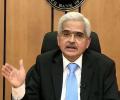
The Reserve Bank of India on Wednesday decided to keep the policy rate unchanged for the tenth time in a row but changed its stance to 'neutral' that may lead to a cut in the forthcoming policies. RBI maintained status quo despite the US Federal Reserve lowering the benchmark rates by 50 basis points last month.

India's economic growth forecast for 2025 has been revised downward to 6.3 per cent, and despite a projected moderation, the country remains one of the fastest-growing large economies, supported by resilient consumption and government spending, the United Nations has said.

Wholesale price inflation dropped to 0.85 per cent in April as prices of food articles, manufactured products, and fuel eased, government data showed on Wednesday. WPI-based inflation was 2.05 per cent in March. It was 1.19 per cent in April last year.

President Droupadi Murmu's address to the nation on the eve of the 79th Independence Day.
The Indian economy is projected to grow at 6.2 per cent in 2025-26, slower than earlier estimated rate of 6.5 per cent, due to escalated trade tensions and global uncertainty, the International Monetary Fund (IMF) said on Tuesday. "For India, the growth outlook is relatively more stable at 6.2 per cent in 2025, supported by private consumption, particularly in rural areas," IMF said in its World Economic Outlook (WEO).

Wholesale price inflation (WPI) declined to a 14-month low of 0.39 per cent in May on easing prices of food articles and fuel, and experts said geopolitical tensions could push up prices.

S&P Global Ratings on Thursday said the hostilities between India and Pakistan heighten risks to the credit metrics of both countries, and any escalation in clashes would put downward pressure on sovereign credit support.

The Trump trade shock is a chance to push long-overdue reforms, rather than tinker with tariffs to appease the US, suggests M Govinda Rao.
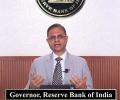
'India has the potential to grow at more than 7%, with the monetary policy providing a supportive hand.'

'A large part of my effort will be solving issues for the whole of Sugar Land, all communities, all populations.'
The RBI's monetary policy committee is expected cut benchmark interest rate by 25 basis points in its policy review meeting next month to push growth, India Ratings and Research (Ind-Ra) said on Thursday. "We expect the headline inflation in FY25 to cool off to 4.7 per cent. Monetary easing may be limited to 75 bps in FY26," Ind-Ra Chief Economist and Head Public Finance, Devendra Kumar Pant said.

It will be the second Budget of the Modi 3.0 government and eighth straight Budget for Nirmala Sitharaman, rare in Indian polity.

An Indian commerce ministry team will soon visit Washington for another round of talks on the proposed trade agreement with the US to iron out differences in sectors, like agriculture and automobiles, a government official said on Thursday.
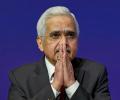
The highlights of RBI's bi-monthly monetary policy announced by Governor Shaktikanta Das:

The International Monetary Fund (IMF) has slapped 11 new conditions on Pakistan for the release of the next tranche of its bailout programme and warned that tensions with India could heighten risks to the scheme's fiscal, external, and reform goals, according to a media report on Sunday.

India has extended duty-free imports of urad for another year until March 31, 2026, according to a government notification. The provision was earlier in place until the end of March this year.

In Q1FY26, the bank reported fresh slippages of 8,200 crore, up 71 per cent Y-o-Y and sequentially. Of this, 7,500 crore is from the retail segment.
The Reserve Bank on Thursday affirmed its commitment to continue with its supervisory measures aimed at early identification of risks and vulnerabilities. The central bank would also focus on enhancing cyber resilience and capabilities of Supervised Entities (SEs) by implementing the recommendations of the inter-regulatory Working Group, which has uniform baseline cybersecurity guidelines for financial entities, it said in its annual report.

'We continue to view India as a standout within EM.'

The repo rate cut by 25 basis points by the monetary policy committee (MPC) of RBI announced Friday will give a long-awaited relief on interest rates and also be supportive of economic growth, according to experts. Repo rate is the interest rate at which the RBI lends money to commercial banks.

To help you ride the growth trajectory of India's equity markets, we have curated the top five fastest-growing stocks that hold an impressive upside. If you're planning to build a sound portfolio and capitalize on the growth of these leading institutions, it's time you watch these stocks.

After registering a positive growth for two months, India's exports slipped into negative territory again, contracting 2.17 per cent year-on-year to $38.73 billion in May due to a fall in global petroleum prices, while trade deficit narrowed at $21.88 billion during the month.
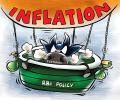
The Reserve Bank on Wednesday lowered the inflation projection for the current fiscal to 4 per cent from 4.2 per cent earlier, taking into account good agricultural output and falling crude prices.
Geopolitical tensions, trade policy uncertainties, volatility in international commodity prices and financial market uncertainties pose considerable risks to India's economic growth in the coming year, the finance ministry cautioned on Wednesday. "Global trade continues to be affected by uncertainty in the policy environment... tariff-related developments in multiple countries have heightened trade-related risks, affecting investment and trade flows globally.
Fitch Ratings on Monday said India's pace of debt reduction is gradual, leaving room for a downside risk to sovereign rating in the eventuality of a significant economic shock. However, the rating agency expressed confidence in India's ability to stick to its medium-term fiscal framework, which aims to reduce debt and bring it on a downward trajectory over time.

The International Monetary Fund (IMF) has said its executive board granted $1 billion in assistance to Pakistan this month after finding out that the country met all conditions and targets for it.

The risk-reward for the Indian markets, Morgan Stanley said, is turning favourable.

India will oppose the World Bank funding to Pakistan next month, arguing that Islamabad has used such funds in the past to procure arms and ammunitions. India previously lobbied against the IMF extending a USD 2.3 billion assistance to Pakistan earlier this month, presenting evidence of Pakistan's misuse of funds for military purposes. India feels that Pakistan has failed to act on terror emanating from its territory and has been diverting funds from multilateral agencies to buy arms and ammunition.


Global funds have pulled out Rs 1.54 trillion from domestic stocks in fiscal 2024 - 25 (FY25), the highest-ever outflow recorded so far, according to the data compiled by Business Standard. The last time the global funds exited Indian shores in droves was back in 2022, when they sold a net Rs 1.41 in the backdrop of Covid-19.
 © 2026 Rediff.com - Advertise with us - Disclaimer - Privacy Policy - Sitemap - Feedback - About us - Terms of use - Grievances